How to Cast I Ching: Timing, Questions, and Ritual
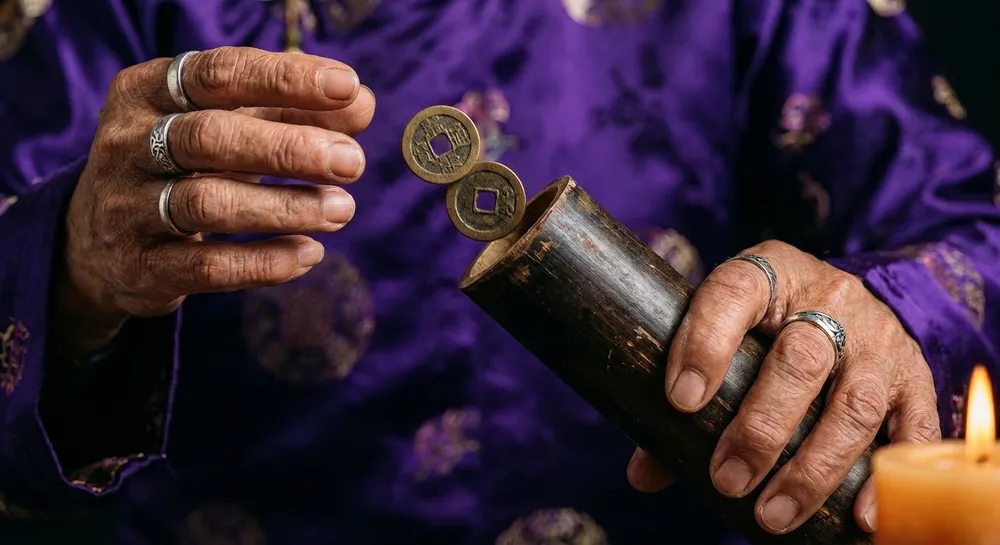
Casting the I Ching is a simple ritual that turns a real question into a hexagram, a stack of six lines. Three steps: settle the question, throw six times, and record each line from the bottom up. The timing matters less than the question, and the question matters more than the method.
- Cast only when you face a real decision you can act on.
- Hold one question per cast. One hexagram, one answer.
- Throw six times and record every line from the bottom up. Order is the ritual.
- Re-asking the same question to "check" cancels the answer.
- Read in three passes: hexagram name, judgment, then any moving lines.
When to Cast
The I Ching is a mirror, not a fortune machine. It reflects the shape of your situation so you can move within it. So the first rule is plain: cast only when you have a real question.
A real question meets two tests. First, it concerns a decision that is yours to make. A job offer. A move. A conversation you keep avoiding. Second, you can act on the answer. "Will my team win on Saturday?" fails both tests. The outcome is not yours, and no reading will change it.
Don't cast when your mind is churning. Anger, panic, and late-night fear will take whatever hexagram you throw and read their own story into it. Wait an hour. Write the question down. If it still feels true in the morning, it is a question worth asking.
And never re-ask. The moment you cast the same question a second time to check the first answer, you have stopped consulting and started bargaining. The classic text has a name for this. From Hexagram 4, Meng (Legge renders it "Măng"), the hexagram of the student, in the 1899 translation by James Legge:
"When he shows (the sincerity that marks) the first recourse to divination, I instruct him. If he apply a second and third time, that is troublesome; and I do not instruct the troublesome."[1]
One sincere question, asked once. That is the contract.
How to Hold a Question
This is the part most people skip. The question you carry into the cast shapes everything that comes back.
One question per cast. "Should I quit my job?" is one question. "Should I quit my job, and what about my apartment, and how do I tell my boss?" is three questions wearing a trench coat. The hexagram will answer all three at once, which means it answers none.
Frame it as an open question. A hexagram is a picture of a situation, not a yes or no switch. "Will this job make me happy?" asks for a binary the I Ching was never built to give. "What should I understand about this job before I decide?" points the mirror somewhere useful. You lose nothing by asking better.
The source text makes the same point. The Judgment of Hexagram 4 describes the learner coming to the teacher, never the teacher chasing the learner. Legge again:
"I do not (go and) seek the youthful and inexperienced, but he comes and seeks me."[1]
The initiative belongs to the questioner. No ritual can force the oracle to speak. Legend, if you want it, credits the trigrams to the mythic sage Fu Xi and the judgments to King Wen, while scholars date the book's layers centuries apart. The practice itself has stayed stubbornly practical: a question, honesty, and a handful of tosses.
The Casting Sequence Step by Step
You have a question and a quiet mind. Here is the whole ritual, in order. (Which tool you use, coins or yarrow or the online caster, is a separate conversation; every method feeds the same six throws.)
Throw for line 1. Make the throw. The result marks your bottom line, and there are only three kinds of result: a solid line, a broken line, or a moving line, which is a line caught in the act of turning into its opposite. In Chinese these are yin (broken) and yang (solid), and "line" means one throw's result, written in the text as a single 爻.
Record it immediately. Write the line down as thrown, with its position number. Do not trust your memory for six throws, and do not tidy up a result you did not like. A hexagram is built from what actually happened, not from what should have.
Throw lines 2 through 6. Each throw adds one line on top of the previous one. Six throws, six lines, one hexagram. The stack grows upward, and the reading assumes you built it that way.
Why the order cannot be flipped. This is where beginners stumble. A hexagram is a picture, and in this system position is meaning. The bottom line is the ground: the start of the situation. The top line is the crown: how the situation presents itself in the open. The lines between carry roles of their own. The sixty-four hexagrams are numbered by these exact stacks, so a stack recorded upside down is not the same answer in a different order. It is a different hexagram and a different reading. The original text numbers the bottom line as line one, so the convention runs through the oldest strata of the book. Bottom to top, throw by throw, no exceptions.
What to Do With the Result
You have your hexagram. Read it in three passes, and resist the urge to speed-read.
The name. Every hexagram has a name that orients you in one phrase: The Creative, The Receptive, Youthful Folly. Sit with the name before reading another word.
The judgment. The judgment is the short main text under the name, the hexagram's core statement about how the situation behaves.
The moving lines. A moving line marks where your situation is in motion, and its own text speaks to your question directly. If several lines move, the highest one carries the most weight, and the movement can transform the whole hexagram into its companion form.
For the full interpretive sequence, the reading guide walks through it with a worked example. Every one of the sixty-four hexagrams also has its own reference page, such as the one for Hexagram 4.
Then stop. Take one action away from the reading. If something confuses you, set it down and come back tomorrow. Do not re-cast to clarify.
FAQ
Yes, and people do, mostly for partners and children. The caution: the answer speaks to your relationship with them as much as to their situation. It works best when the question is one you can act on together.
A moving line is a throw that did not land as a plain yin or yang line. It is a line mid-transformation, marked as changing. It is the part of the reading that speaks most directly to your question, because it flags where the situation is in motion.
As often as you have real questions. The I Ching prefers need over calendar. Casting daily to "stay in practice" usually ends in ignoring answers, so most long-time readers cast a handful of times a month at most.
No. The ritual is attention, not props. One question, six honest throws, a written record. Ceremony is optional; sincerity is not.
- Legge, James (trans.). The Yî King, Sacred Books of the East vol. XVI, 1899. Hexagram 4, Măng — the Judgment, quoted above on the one-question-one-answer contract.
- Read the Măng hexagram in full on this site: /hexagram/4/
One honest question, asked once — then let the six tosses answer.
Cast your first hexagram — freePrefer to compare methods first? Read the coin vs. yarrow guide · Already cast? See the reading guide or the Hexagram 4 reference.