Coin Method vs Yarrow Stalks vs Online Casting: Which Way to Ask the I Ching
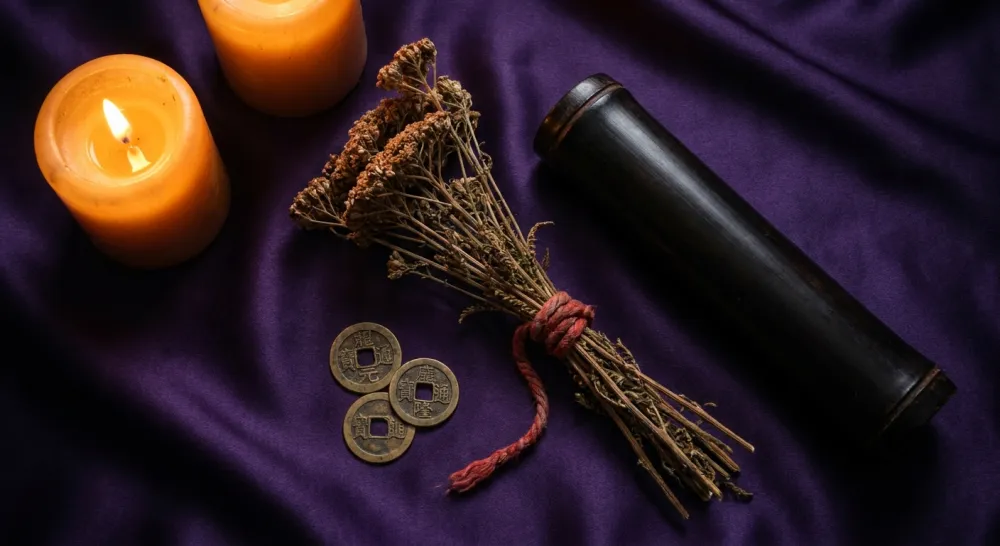
- Coins: three coins, six tosses, four outcomes per line. Fast, portable, and the modern standard.
- Yarrow stalks: the original 2,500-year-old ritual. Slower, and it makes old yang (moving) lines more likely.
- Online casting: the same coin math, no physical props. Fine for daily practice, same oracle.
- Want to skip the theory and cast a hexagram now? It takes two minutes.
All three methods build the same sixty-four hexagrams from six lines, but they feel different. Coins are fast and portable. Yarrow stalks are slow, ceremonial, and tilt the odds toward old yang. Online casting keeps the coin math and removes the props. None is more accurate than the others. What changes is how you ask.
Which Coins to Use
Any coins work. Three coins of the same denomination, so they have identical weight and feel, is all you need.
Traditional Chinese cash coins have a characters side and a blank side. In the classic method, the blank side (背) counts as 3 and the characters side counts as 2. Modern coins have no characters to lean on, so you just decide which face counts as 3 before you start. Pick heads or tails, stick with it for all six tosses, and you are doing it right.
What matters is not the metal. It is consistency. Casting with a quarter, a yen coin, or a handful of loose change gives the same hexagram. The coins are a tool for slowing you down, not a talisman.
The Four Outcomes of Each Toss
Each line comes from one toss of three coins. Add the values: 3 for each back, 2 for each characters side. The sum is either 6, 7, 8, or 9, and each sum means a different kind of line.
| Backs up | Characters up | Sum | Line type | Meaning |
|---|---|---|---|---|
| 3 | 0 | 9 | Old yang | Moving line |
| 2 | 1 | 8 | Young yin | Stable line |
| 1 | 2 | 7 | Young yang | Stable line |
| 0 | 3 | 6 | Old yin | Moving line |
A moving line (动爻) is a line that is about to flip: old yang turns into a broken line, old yin turns into a solid line. When you mark your hexagram, record the moving lines, then draw the changed lines underneath. That second stack, the derived hexagram, is the oracle's comment on how the situation develops after your first reading.
Six tosses, recorded bottom to top, make one hexagram: six lines that stand for your situation. If all six lines are stable, the reading is just the one hexagram. If any line moves, you read the Judgment of the first hexagram, then the lines that moved, then the derived hexagram.
Coin vs Yarrow Probabilities
The yarrow method is the classic one from the oldest strata of the tradition: take 49 stalks, divide them into two bundles, cast off bundles of four, and the leftover count gives you the same 6, 7, 8, or 9. It is a beautiful ritual, and it is slow. One hexagram takes about twenty minutes of full attention.
The math is where the two methods part ways. With three coins, all eight outcomes are equally likely, so a moving line comes up evenly on both sides. The yarrow stalk procedure is different: the leftover counts are not distributed evenly, and the calculation favors 9.
| Outcome | Coin method | Yarrow stalks |
|---|---|---|
| Old yang (9, moving) | 1/8 | 3/16 |
| Old yin (6, moving) | 1/8 | 1/16 |
Probability of a moving line
In plain terms: yarrow gives you about three times as many old yang as old yin, while coins split the moving lines evenly. If you want readings that tilt toward beginnings, expansion, and action, the stalk method delivers more of that energy. If you want the most even, neutral distribution of any method, three coins are the cleanest choice. Neither is "better." They ask with different accents.
Does Online Casting Count?
It does, and it is worth saying why honestly.
The I Ching was never about the physical object. The original oracle of the Zhou dynasty used yarrow stalks. Somewhere in the intervening centuries, practitioners switched to coins because stalks were cumbersome and rare. The coin method was itself a convenience upgrade. Online casting is the same upgrade again: coin math, instant tally, no table needed.
What online casting removes is the ritual. The slow pass of forty-nine stalks, the soft fall of coins on a table, the minutes of silence while the question settles. That time is not wasted. It is where most of the work happens.
So be honest with yourself. If the ceremony is part of the point for you, cast with real objects. If the ceremony is friction that keeps you from asking at all, cast online. The oracle does not know the difference, because the oracle is the question you bring. A focused mind pressing a button gives better readings than a distracted one fumbling with coins.
The modern version removes the props but keeps the math: same four outcomes, same six lines, same derived hexagram, logged so you can review your readings later. That is a feature, not a compromise.
Common Mistakes
Re-casting the same question. The biggest one, and the classics deal with it directly. The Judgment of Hexagram 4, Măng (Inexperience), as translated by James Legge in 1899:
When he shows (the sincerity that marks) the first recourse to divination, I instruct him. If he apply a second and third time, that is troublesome; and I do not instruct the troublesome.[1]
The text is over two thousand years old, and it already knows what you will do: you will not like the answer, so you will toss again until you get one you like. That is not divination. That is shopping. One cast, one answer, then work with it. If you want the full context, read theMăng hexagram in full.
Copying lines down wrong. Record from the bottom up, every time. A single line swapped from top to bottom changes the derived hexagram entirely, and you will blame the oracle for a typo.
Switching which face counts as 3. Decide once, before the first toss. Flip-flopping mid-cast quietly breaks the math you think you are running.
Asking a yes-or-no question. The I Ching answers situations, not ballots. "Will I get the job?" is a coin flip in question form. "How should I prepare for this interview?" is a question the hexagram can actually answer.
Refusing to accept the derived hexagram. The moving lines are not a mistake. The changed lines are the whole point of the system: the situation in motion. Read them. The Creative, for instance, is a clean and powerful answer on its own, and it becomes something else entirely when you watchHexagram 1 move.
FAQ
Yes. Three coins of the same denomination work perfectly. Chinese cash coins are traditional, but modern quarters, pennies, or any coins you have on hand are fine. Just decide which face counts as 3 and keep it consistent for all six tosses.
None. Coins, yarrow stalks, and online casting all produce the same 64 hexagrams from the same rules. Accuracy is not a property of the tool. It is a property of the question: a clear, sincere question cast once beats a sloppy question cast a dozen times.
Yes. Online casting runs the exact coin-method math: same four outcomes, same six lines, same derived hexagram. It is the same ritual upgrade that replaced yarrow stalks with coins thousands of years ago. What matters is the sincerity you bring, not whether you touched physical objects.
The stalk counting procedure distributes its leftover counts unevenly. The result is that old yang comes up at 3/16 with yarrow versus 1/8 with coins, and old yin drops to 1/16. If you want readings rich in moving yang energy, use stalks. If you want an even distribution, use coins.
- Legge, James (trans.). The Yî King, Sacred Books of the East vol. XVI, 1899. Hexagram 4, Măng — the Judgment, quoted above on re-casting a question.
- Line probabilities follow the standard analysis of the three-coin toss (1/8, 3/8, 3/8, 1/8) and the yarrow-stalk count distribution (3/16, 7/16, 5/16, 1/16).
- Read the Măng hexagram in full on this site: /hexagram/4/
You now know everything the tools can and cannot do. The next step is not more reading. It is one honest question, asked once.
Cast your first hexagram — free